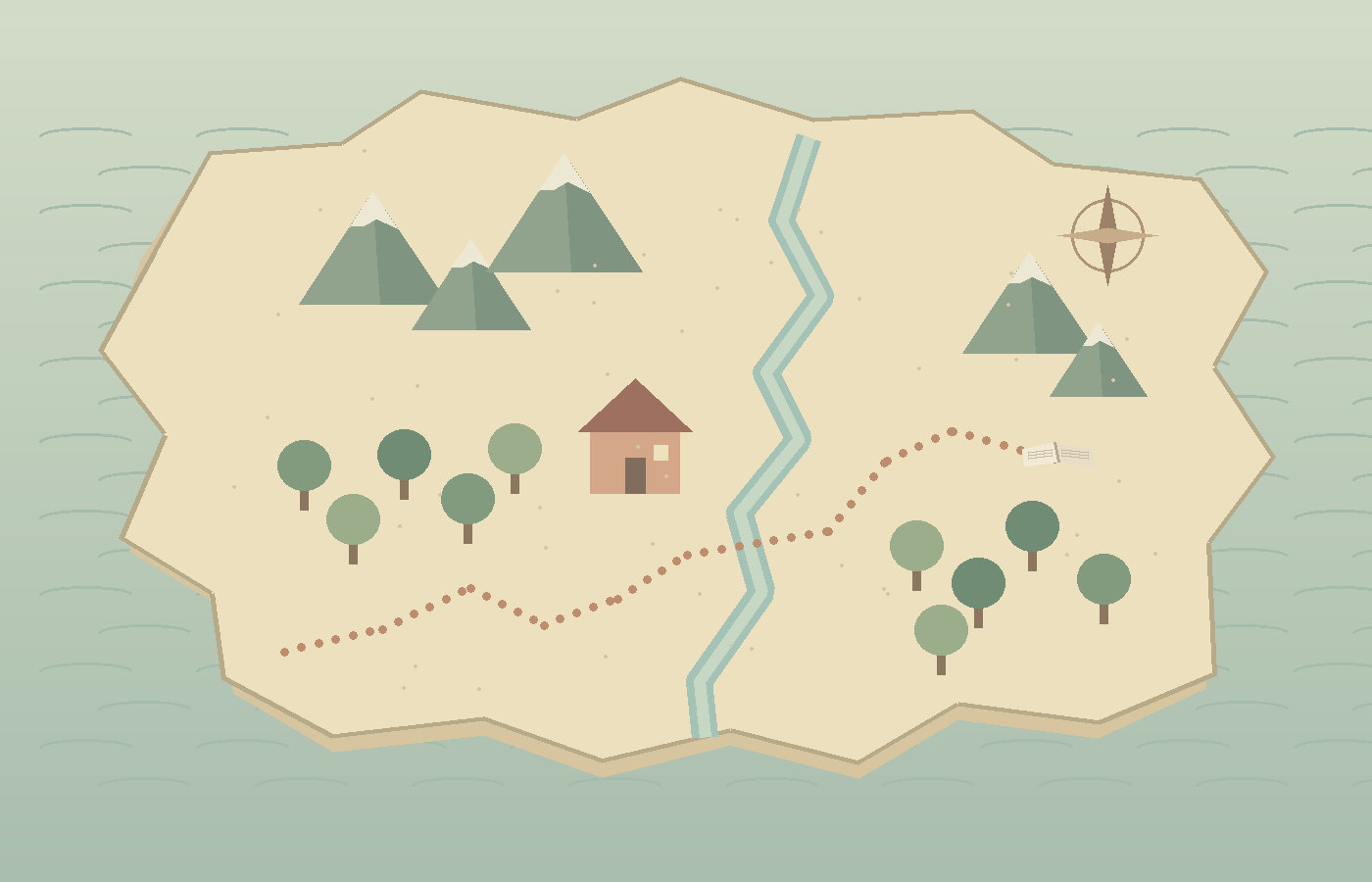
The map in the front of Nella’s book had been folded so many times that the river disappeared at the crease. It began confidently in the northern hills, ran through a forest of tiny pointed trees, and then broke off in a white line. On the other side of the fold it continued toward the sea, somewhat wider and under a different name.
“A mistake,” said Nella’s brother, who liked mistakes best when somebody else had made them.
But Nella held the page toward the window. The light came through the thin paper and showed a few pale fibers where the ink had rubbed away. She thought the river looked less broken than hidden, as if it had gone underground for a little distance and come out changed by the dark.
The map showed the bridges but not the bells. It showed a square called Market of Rain, although the story mentioned that place only once: a porter passed through it carrying a rolled carpet and thinking of lunch. Nella read the sentence three times. She wanted to know what was sold in the market, whether the carpet was heavy, and whether the porter found a dry step where he could eat.
Her brother said, “If the author wanted you to know, it would be there.”
“Perhaps it’s there,” Nella said, “but not in the part with words.”
The book belonged to the schoolroom cupboard, where the children chose their Friday reading. Nella had borrowed it for its plum-colored cover and found inside a story about a woman who repaired bells in a city built on bridges.
On Saturday she took the book to the kitchen table and copied the city in pencil. She drew the broad river first, then the islands, then the bridges, which looked like stitches made by a patient hand. Her first bridge was too short; her second reached the wrong island. By the fourth, the city had changed shape enough that she could no longer fit the western gate on the page.
She turned the paper over and began again, this time leaving out the gate on purpose. In its place she put a flight of steps down to the river. On the steps sat the porter, eating a pear. He had set the carpet beside him, and one corner had unrolled in the damp. Nella colored the pear yellow, then gave the porter a red scarf so that she could find him again.
She added a narrow lane that ended at a wall. Her brother, looking over her shoulder, wanted to know why she had drawn a road with nowhere to go.
“It used to go somewhere,” Nella said. “The wall is newer.”
“What happened on the other side?”
Nella looked at the small blank space beyond the wall. It was just wide enough for a thumbprint. She had no answer, and the lack of one made her unexpectedly cheerful. She folded the map and put it inside the book, not to finish the city but to keep a place open in it.
The Cartographer’s Table
In another story, in a house that existed only while a reader held it in mind, an old cartographer named Esen was commissioned to map a valley no one could enter by the same path twice.
Esen did not believe in the commission. He believed in boots, rain, the wobble of an ink bottle on an uneven table, and the tendency of wealthy patrons to ask for impossible things without adjusting the fee. Still, he accepted, because the roof needed repair and the patron had paid half in advance.
The next morning Esen found a gap in a stone wall and stepped through into an orchard. A woman stood among the trees, collecting fallen pears in her apron.
“What is this place called?” Esen asked.
“I call it home,” said the woman. “My sister calls it the orchard. The people in the village call it troublesome.”
He wrote down all three names. When he asked why the villagers found it troublesome, she pointed to a branch. A pear dropped from it into his hat.
“They say the fruit is impatient,” she said. “I say they stand under the trees too long.”
Esen marked the orchard in his notebook and returned to the gap. The next morning he followed the same sheep track, or thought he did, but found a pond edged with rushes. A boy was sitting on a stone, mending a net.
“Where is the orchard?” Esen asked.
The boy looked up. “Across the pond, I expect.”
There was no orchard across the pond. There was a slope of gray grass and a donkey with one ear bent. Esen walked around the water anyway. By the time he reached the far side, the boy had disappeared, leaving the net neatly folded on the stone.
Beyond the stone stood a door without a house. Esen tried the handle. It would not turn, so he sat against the door to consider the pond and his increasingly damp boots.
When he leaned back, the door opened. On its other side was the woman’s orchard. She was up a ladder, knocking pears from a branch into a basket.
“You might have warned me,” Esen said.
“About the door?” She climbed down. “It wasn’t there yesterday.”
He showed her his notebook. Its pages were crowded with crossings-out. The pond occupied the same place as the orchard; the mill had been drawn three times, each time beside a different road. At the bottom of one page he had written, in a hand that surprised him with its smallness, I am lost.
The woman studied the drawings. “You’ve put everything down as if the valley were waiting for you to look at it.”
“That is generally how a map works.”
“Then perhaps you need another kind.”
Esen wanted to argue, but she had already set the basket down and was sorting the pears into two piles. Some were bruised; some were not. She gave him a sound one and kept a bruised one for herself.
Back at his table, he spread a clean sheet of paper. Instead of drawing a single valley, he drew seven small ones. In the first was an orchard reached by a gap in the stones. In the second was a pond reached by what appeared to be the same gap. Between the pictures he added dotted lines, questions, and notes about weather, time of day, and whether he had been hungry. He left room for an eighth valley at the bottom of the page.
A Shore on the Kitchen Floor
Years after Nella’s schooldays, in a different town and a different kind of house, a child named Arun found a coastline in a book with no map at all. The coast appeared in a single paragraph: a traveler came down a dune, saw the sea, and noticed a line of blue pots drying outside a house. The traveler did not stop. He was late for a ship, and the story hurried after him.
Arun wanted to stay with the pots. He asked his aunt why they were blue.
“Perhaps the potter had blue paint.”
“Why did she put them outside?”
“Perhaps there was no room inside.”
“What was inside?”
His aunt, who was kneading bread, lifted a floury hand. “You’ll have to tell me.”
Arun fetched a piece of string from the drawer where the household kept useful things that had not yet found a use. He laid it across the kitchen floor to make the edge of the sea. A spoon became the traveler’s ship; an overturned cup became the potter’s house. His aunt contributed six dried beans for pots, though she insisted that two be returned before supper.
The sea kept moving when people walked past. Once, the dog carried off the house. Arun put it back in a different place and decided that a storm had shifted it. He made a harbor from blocks and a road from a folded newspaper. When his aunt opened the oven, a current of warm air lifted one end of the paper, and he declared that the road crossed a hill.
Then his cousin Leila came in, stepped over the string, and sat on the hill.
“That’s the road,” Arun said.
“It’s also where I’m sitting.”
Arun shifted the road around her and asked what belonged at the top of the hill.
“I’m a mountain,” she said. “This is a house.”
“All right,” he said. “But the road goes around you.”
They moved the newspaper together. Leila made a path from the mountain house to the harbor, using crumbs from her sleeve. She said the person who lived there was the potter’s brother and that he kept a goat. Arun said the goat ate fishing nets. Leila said it only ate old ones. They disagreed for a while, and then decided that the goat ate new nets by mistake and old ones on purpose.
The traveler’s ship sailed at last, pushed by the dog’s nose. It caught on the string and overturned. Arun rescued it and put it back in the harbor. This time the traveler missed the ship. He knocked at the potter’s door and asked for a place to sleep.
What the Page Cannot Hold
A map can give a reader a way into a place, but it cannot make the journey in the reader’s stead. The printed line says that a road crosses a hill; it does not say how much a traveler’s pack weighs or whether she stops to take a stone from her shoe. It may show a harbor without showing the person waiting there, impatient for a ship that is late. The road and the harbor become more particular as a story moves through them, and sometimes a reader keeps making them particular after the story has moved on.
Nella’s folded city offered her a porter with no lunch. Esen’s valley resisted being reduced to a single view. Arun’s coast began as a glimpse from a dune and acquired a goat only because Leila sat down in the wrong place. None of these places needed to be complete before someone could enter. Each had enough of an edge, a doorway, or a shore to invite a next step.
When Nella returned the book, she left her drawing between its pages. A few weeks later it came back to her with a ladder sketched on the far side of her wall. She added a small basket at its foot before returning it once more.
At the end of the school year, Nella found the plum-colored book in the cupboard again. Her map was still inside, folded into quarters. On the back, beneath the drawing of the ladder, someone had made a second picture: the porter standing at the top of the wall, holding out his red scarf to a person below. Nella could not tell whether he was offering help or asking for it.
She took a pencil from her pocket and drew a hand reaching up. Then she hesitated. A face would have decided too much, so she left it out. There was room on the paper for the other reader to continue, and room in the city for both of them to be surprised.
← Chapter 3: The rooms books make | Contents | Chapter 5: The garden between pages →