I. The Gate
The gate to the garden would not stay shut unless its latch was lifted twice. The first lift merely made a sound of agreement; the second let the iron tongue settle into its socket. Anyone who knew the gate performed the little ceremony without looking. Strangers often walked away after the first click, and the gate swung slowly open behind them, as though reconsidering an invitation.
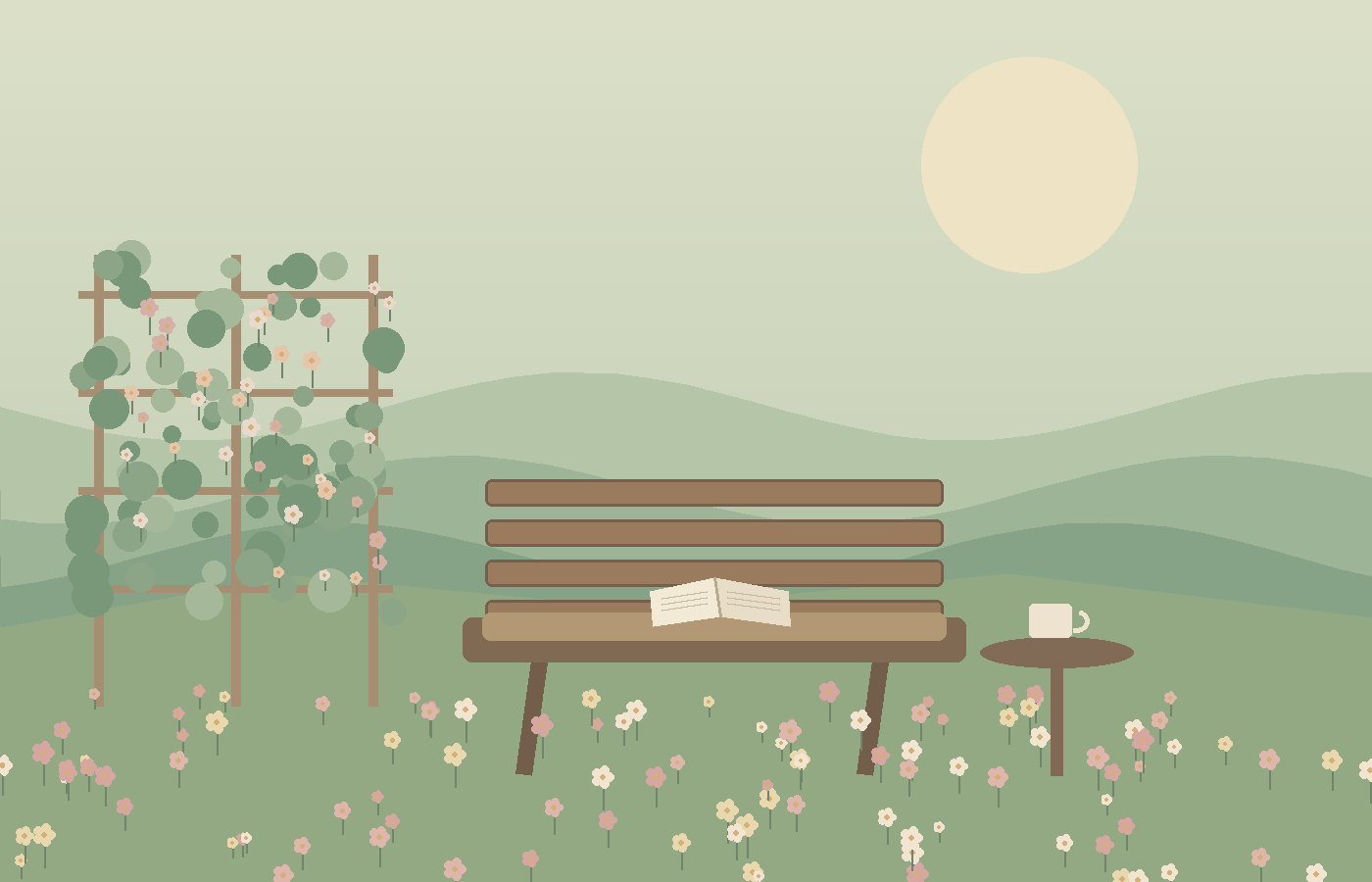
At the far end of the path stood a bench with one short leg. Its defect had been corrected with a square of slate, which disappeared whenever the soil was turned and reappeared, washed and dark, after rain. On the bench, when the weather permitted, sat a woman named Esther with a book on her lap and a basket at her feet. She was not the owner of the garden. She rented the rooms above the baker’s shop and had been given a key by the owner, who could no longer manage the steps down to the gate. The key was brass and too large for Esther’s pocket, so she tied it to the handle of the basket with a blue ribbon.
Esther came partly to pull weeds and partly to read. At first she had tried to keep these occupations separate, as if one might accuse her of neglecting the other. She would work until the basket was full, place it neatly beside the bench, and open her book only after checking the path for anyone who might need to pass. Then she began to notice that the best place to consider a difficult sentence was sometimes on her knees beside the parsley. There was room there for a thought to remain unfinished while her hands found the roots of a plant she did not want.
II. The Things Used as Markers
Esther’s friend Nella, who lived two streets away, had a habit of marking her place with whatever lay nearest: a bus ticket, the paper band from a loaf, a piece of thread. She maintained that a proper bookmark was an invitation to lose a proper bookmark. Esther disapproved of this practice until the day she borrowed a novel from Nella and found, halfway through it, a narrow list written in pencil.
The list began with onions and soap. Below these were the words ask about the blue cup, followed by a sum that had been crossed out so vigorously the paper was nearly torn. Esther knew the cup. It had belonged to Nella’s brother, who had moved away the previous spring and left several boxes in her hall. Esther had assumed that sorting those boxes was a task Nella meant to do on a wet weekend. The list made the matter look less like a task than a question that had been carried around for some time.
When she returned the book, Esther slipped the list out and offered it back. Nella studied it, then laughed at the onions, which she had forgotten to buy. At the mention of the cup she stopped laughing. She said her brother had asked her to keep it safe and then, on his last visit, had gone home without it. She could not decide whether he had forgotten or whether he no longer wanted it. Neither possibility seemed worth a letter, yet the cup stood on the shelf where she saw it every morning.
“You could ask,” Esther said.
“That is what the list says.” Nella folded the paper carefully, along the old crease. “I may yet.”
She came to the garden the following Thursday carrying the cup wrapped in a dish towel. It was blue only on the outside; its inside was white, with a faint crack near the handle. Nella set it on the bench between them while they drank tea from two sturdier cups. Then she took out a postcard and wrote to her brother. She did not ask whether he wanted the cup. She told him she had it, that it was safe, and that she hoped he had found a good place for his books.
“That is not quite the same thing,” Esther said when Nella read the message aloud.
“No,” said Nella. “But it is a beginning.”
III. A Bed of Beans
There was a boy called Kit who passed the gate on his way home from school. He had learned to pause at the first click when someone came out, waiting to see whether the second would follow. If it did not, he ran back and lifted the latch. Esther once thanked him, and thereafter he greeted her as if the gate were a duty they shared.
One day he found her measuring a patch of bare ground with a piece of string. She held one end against a brick and asked whether he would put his finger on the other. He did so with the solemnity of someone assisting in a delicate operation. She pushed a stick into the soil at his finger, stretched the string to another brick, and made a second mark.
“What is it going to be?” he asked.
“Beans, I hope.”
Kit looked at the empty patch. “How many?”
“I have not counted the seeds yet.”
“Then how do you know it is big enough?”
Esther considered the string, the bricks, and the little brown packet in her basket. “I do not. Shall we count them?”
Kit returned with a book the next day. It had a green cloth cover and a drawing of a spade on the front. He had borrowed it from his grandfather, who had put folded scraps of newspaper between several pages. They opened it on the bench and read a passage about preparing a bed. The book was more confident than Esther felt. Its instructions assumed straight rows, sound labels, and a gardener who had not already lost a seed in the grass.
They followed what they could. Kit made holes with a short stick; Esther dropped a seed into each one. He covered them with soil and pressed each place flat with his palm. When they came to the end of the row, he wanted to uncover the first seed to make sure it was still there. Esther persuaded him to leave it alone by offering him the job of writing a label. He wrote BEANS on a wooden ice-pop stick, then added his initials on the back, where he thought no one would see.
When the first green shoot appeared, Kit brought the book again and held the picture beside it. The picture showed a tidy stem and two leaves of equal size. Their shoot leaned to one side, and one leaf was folded. Kit looked from the page to the plant and back again.
“It is not finished,” Esther said.
“Neither is the book,” Kit answered. He turned the page to show her the next illustration.
IV. The Owner’s Window
From the upper room of the house, Mrs. Vale could see the pear tree, the bean bed, and a triangular piece of the path. The rest of the garden lay beyond the angle of her window. She had lived in the house for forty years and knew what was hidden: the potting table beneath the wall, the uneven paving stone near the tap, the patch where mint had spread farther than she intended. Her view was small, but it was not empty beyond its edges.
On Friday Esther read aloud from a novel in which a family sat down to dinner. Halfway through the meal Mrs. Vale interrupted to say that the table was too small for the number of people described. Esther counted the chairs mentioned on the previous page. There were not enough. They debated whether someone might have fetched a stool from another room, and Mrs. Vale proposed that the author had simply forgotten the youngest child.
Esther tried to continue, but every time another dish was passed, Mrs. Vale asked how it could travel around the table without knocking over a glass. They laughed so much that the scene had to be abandoned. When Esther closed the book, Mrs. Vale held out her hand for it. She wanted to examine the passage herself after supper. The following Friday she returned it with a strip of paper marking the page and a note: There is room if the youngest sits at the corner.
V. What the Rain Left
In late summer a hard rain came during the night. Esther reached the garden in the morning to find the path scattered with leaves and the bean supports leaning over the bed. The slate had slipped from under the bench. Water stood in the blue cup, which Nella had brought back for safekeeping after her brother postponed his visit. Esther emptied it into a pot and set it upside down on the bench while she fetched string.
Kit arrived before she had tied the first support. He wore boots too large for him and carried the green book beneath his coat. They straightened the poles together, pressing their feet into the wet ground for purchase. One stem had snapped. Kit held its broken end in his hand while Esther tied the others. He asked whether they could mend it with string too.
“We can tie it up,” she said, “but I do not know if that will mend it.”
They tried a loose tie. Later the leaves on that stem drooped, and Kit asked if he should cut it away. Esther gave him the small scissors from her basket. He cut carefully, not quite at the place she had pointed out, then laid the stem on the path. There were two beans on it, both small. He asked whether they could take them upstairs to Mrs. Vale. Esther said they could.
Mrs. Vale received the beans on a saucer. Kit explained the rain, the leaning poles, and the attempted repair, leaving nothing out. She listened without interrupting. Then she asked him to open the green book at the page he liked best. He chose an illustration of a person carrying a watering can, with a dog following close behind. Mrs. Vale said the dog looked as though it had somewhere more interesting to be. Kit disagreed. He thought it was waiting to be given a job.
While they discussed the dog, Esther looked out of the window. From there she could see the top of the bean bed and the gate beyond it. Nella was coming up the path, holding an umbrella that had turned inside out. She wrestled it closed, glanced toward the window, and raised one hand. In the other she carried a parcel wrapped in brown paper.
It was a book for her brother. She had decided to send it with the cup after all, properly padded in a box. The book had belonged to him when they were children; she had found it behind a row of jars in her kitchen. On the flyleaf he had written his name in enormous letters and, underneath, a warning against borrowing without permission. Nella showed them the inscription. The last word ran downhill because he had run out of space.
“Did you borrow it?” Kit asked.
“Frequently,” Nella said. “I do not remember asking.”
She opened the book to a page marked with a piece of ribbon. There was a picture of a house with a garden so crowded with flowers that the front door was almost hidden. Nella remembered wanting to live there. Mrs. Vale said she would have preferred a clearer path. Kit studied the drawing and announced that there was a gate behind the largest flower, though none of the others could find it.
Before leaving, Nella wrote a note to put inside the parcel. She asked her brother to tell her where the book had been meant to live, and whether he remembered the garden in the picture. Then she wrapped the cup again, adding a second towel around the handle. Esther found a box and Kit filled the gaps with crumpled paper. They shook it gently, listening for movement, and added a little more.
At the gate, Kit lifted the latch twice behind them. Esther looked back. The bench was still uneven, and the slate lay beside it where she had set it down. She would replace it on her next visit. For now the bean poles stood upright, the cup was on its way to its owner, and upstairs an unfinished novel lay within Mrs. Vale’s reach.
Kit walked with Esther as far as the baker’s shop. He carried the green book against his chest, holding it closed with both hands. At the corner he stopped to show her something between its pages: a bean leaf, flattened but still green at its center. He had picked it from the broken stem when she was not looking. He asked whether it would stay that color. Esther said she did not know. They opened the book once more to see where he had put it, then closed it gently and went their separate ways.
← Chapter 4: The country beyond the fold | Contents | Chapter 6: The water’s edge →